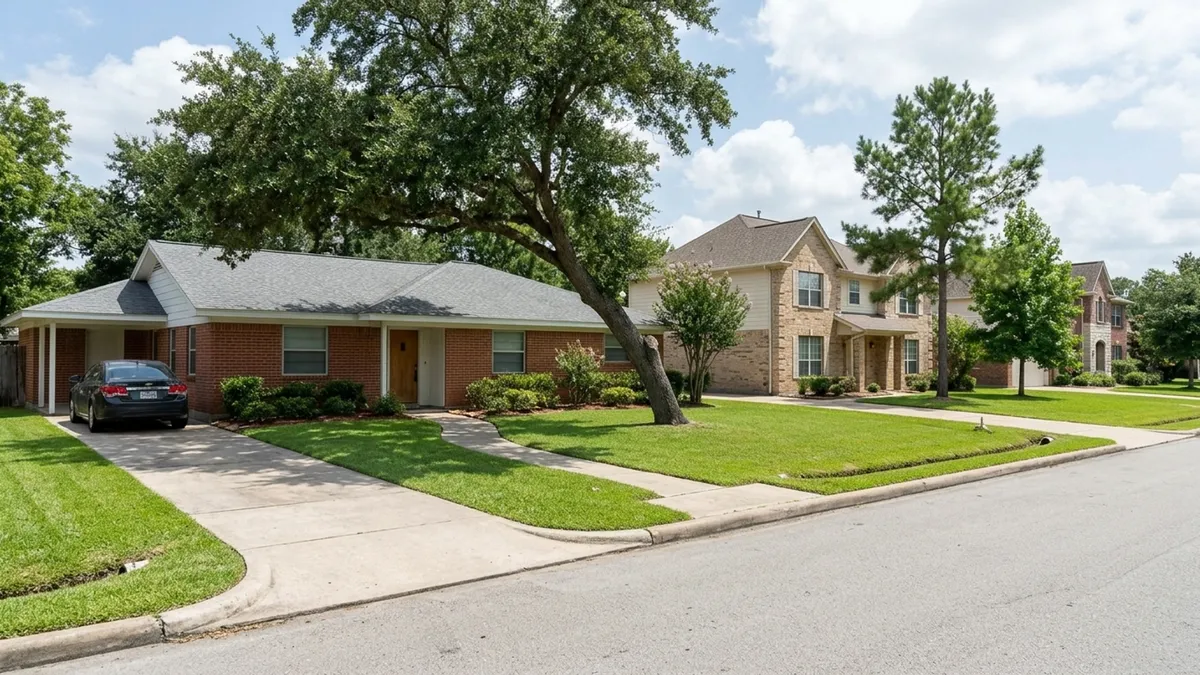
What to Expect When Investing in Friendswood, TX Real Estate in 2026
Friendswood's single-family median sale price has dropped to $419,833, while supply sits at just 2.8 months for the 90 days ending September 30, 2026. You can buy a detached house about $50,000 below last year's level, but don't expect fire-sale negotiations: the typical home still sells within a few percent of its list price.
The case for buying here is a long-term one. That strategy only holds up if local rent covers the non-homestead property taxes and flood insurance that the recent price drop does nothing to reduce.
Key takeaway
The strongest investing case in Friendswood is a long-term single-family rental bought below last year's prices. Prices are down year over year, but supply hasn't piled up, so expect modest discounts rather than fire sales. Flipping is the riskier alternative while prices are still falling, and any plan should pass a rent, property tax, and flood insurance test before you make an offer.
Who this guide is for
You're weighing whether a Friendswood house would pay for itself as a rental or a resale, and you need to know which strategy and which costs to test before making an offer.
Why investors are looking at Friendswood right now
The typical Friendswood house costs about $50,000 less than a year ago, yet there's less than three months of supply on the market. That combination gives buyers a lower entry price without a glut of competing listings to wade through.
For the bigger picture, see Friendswood Housing Market.
Reviewing Friendswood housing market trends shows how this dynamic plays out differently depending on your approach. What you're looking at is a pricing reset, not widespread distress.
How the recent price drop affects your entry point
The single-family median is roughly $50,300 below the implied year-earlier level of about $470,100, based on the year-over-year decline for the 90 days ending September 30, 2026. Supply has stayed thin at 2.8 months, which tells you sellers are adjusting to current rates rather than dumping inventory to get out.
The downside: prices that fell over the last year can keep falling. Buying cheaper than last year isn't the same as buying at the bottom, so the deal has to work at today's price without counting on a rebound.
What to expect during negotiations
About one in seven Friendswood houses still sells above asking, even with prices down. Sellers are accepting slightly under asking, with a typical sale-to-list ratio of 97.7% for single-family homes. That translates to about a 2.3% discount, or roughly $9,900 off a house listed near $430,000.
If you need a 10% discount to make the numbers work, you'll mostly lose to buyers paying close to list. Focus on listings that have sat well past the 31-day median time on market.
Real estate investment strategies for Friendswood
Only 10 of the 226 homes sold in Friendswood over the 90 days ending September 30, 2026, were not single-family houses. This market is overwhelmingly detached properties, and that inventory shapes how investors operate.
If you want a lower entry price on a detached house you'll hold for years, long-term rentals are the natural starting point. If you want a quick profit from a renovation, run the rule against the most recent comparable sales, not last year's. Need rent to cover the mortgage and costs from month one? Go straight to the market rent section and the worked example. If appreciation over several years is enough, long-term rentals are the fit. A short hold points to flipping, where falling prices are the main risk right now.
Holding single-family homes as long-term rentals
This is the default fit because 216 of the 226 recent sales were single-family homes. You can browse the types of homes available in Friendswood to get a feel for the typical layouts and lot sizes.
Verify the school district for any address using the district's boundary lookup rather than the listing description, since boundaries determine which Friendswood schools serve the property.
What you give up is immediate monthly profit. Entry prices near the median make cash flow hard to hit, and the rent test in the next section shows exactly how wide that gap is. Unless your rent research says otherwise, treat this as a hold-for-value strategy.
Flipping houses in a falling market
The standard 70% rule dictates that your maximum purchase price should equal 70% of the after-repair value, minus the cost of repairs. Holding costs run through the rehab period plus a typical month on the market after listing, since the median days on market is 31 for single-family homes.
The catch is real: with the median down double digits over a year, comps pulled at purchase may overstate what the house will sell for after rehab. A flip planned on last spring's sales can lose money even if the work goes perfectly.
Nightly leasing and short-term rentals
No official ordinance text establishing a short-term rental registration or permit program appears on the city's own site. Confirm current rules directly with the city before you go further.
Beyond city rules, many Friendswood subdivisions are deed-restricted. A house can be legal to rent nightly under city ordinance and still be barred by its HOA. Get the restrictions before you make an offer.
Converting a primary residence into a rental
A common path is buying as a primary residence and converting to a rental later. A Texas homestead exemption ends when the home stops being your principal residence. Under Texas law, rental property falls under a different limitation that caps annual appraisal increases at 20%, rather than the 10% cap for homesteads. You can read more about property taxes on the Friendswood cost of living page.
The year the exemption drops is the exact year rental income starts. Budget the non-homestead bill, not the one you paid as an owner-occupant.
What it costs to carry a rental property
A rental bought from day one never had a homestead exemption. For tax year 2026, the City of Friendswood adopted a rate of $0.524843 per $100 property valuation, and Friendswood ISD approved a rate of $1.0249 per $100 valuation.
If you're living in the house now or planning to buy it as a primary residence first, the section above on converting explains how the tax bill shifts. If the house is in a FEMA flood zone or under an HOA, read those sections before you set your numbers, because either one can change the math or the strategy.
Budgeting for non-homestead property taxes
Check the local appraisal district for total rates, including county and drainage district levies. The Friendswood cost of living page has more detail on local levies.
The tax bill follows the appraised value, not your purchase price. Look up the property's current appraised value and any exemptions on the county appraisal district site before you make an offer. The seller's bill may reflect a homestead exemption you won't be entitled to.
Pricing out flood insurance premiums
Texas sellers must disclose whether the home has flooded and whether it sits in a floodplain. Texas Property Code requires disclosure of present flood insurance coverage, previous water penetration, and whether the property is in a 500-year floodplain or flood pool. You can look up the property's FEMA flood zone on the FEMA Flood Map Service Center. The Friendswood seller disclosures page covers these requirements in detail, and the Friendswood weather page gives useful local storm context.
Premiums can turn a rental that pencils out on paper into one that doesn't. Get a flood insurance quote for the specific address and ask for the elevation certificate during the option period.
Factoring in HOA dues and leasing restrictions
HOA dues are a fixed monthly cost that cuts directly into rental income. Leasing rules, including minimum lease terms or rental caps, can dictate whether the property functions as a rental at all.
A leasing cap can make the house unrentable even after you close. Ask the HOA for current dues, pending special assessments, and the deed restrictions on leasing before you're under contract.
Paying buyer closing costs
Closing costs add to the cash you put in and lower your first-year return. You can review the common line items on the Friendswood buyer closing costs page.
Investment-property loans can carry fees an owner-occupant wouldn't see. Ask your lender for a Loan Estimate on non-owner-occupied terms specifically, not the owner-occupied version.
Financing the purchase with an investment loan
Non-owner-occupied loans typically come with a larger down payment and a higher rate than owner-occupied loans. You can track current trends on the Friendswood mortgage rates page.
Ask your lender what the down payment, rate, and Loan Estimate look like on investment-property terms. That difference between the standard residential payment and the actual investment loan payment is often what decides whether the rent covers the debt service.
How to run the numbers on a specific property
To pass the 1% rule on a typical Friendswood house, the property would need to rent for about $4,200 a month. That figure comes from taking one percent of the single-family median sale price. The higher two-percent threshold would require roughly $8,400 a month in rent for the same home. These tests show how much income a property needs to generate to cover its carrying costs.
Finding the accurate market rent
For fiscal year 2026, HUD's Fair Market Rent schedule lists the Houston-The Woodlands-Sugar Land metro area at $2,116 for a three-bedroom and $2,639 for a four-bedroom. Per the U.S. Census Bureau, the median gross rent for Friendswood city is $1,688.
Metro and Census figures blend all housing types and ages. Compare your rent estimate against at least three current comparable rentals near the property, not the metro average.
Applying the one percent rule
The 1% and 2% rules are quick screens to see if monthly rent equals at least those percentages of the purchase price. At the single-family median, passing means about $4,200 a month in rent, which sits well above the Census median gross rent.
These are screens, not verdicts. A house can fail this test and still make sense as a long hold, but you're then relying on appreciation in a market where prices just fell.
Running the numbers on a typical house
Assume a purchase at the single-family median price. A 25% down payment requires about $104,960 in cash, leaving a loan of roughly $314,875. Plug in the exact interest rate your lender quotes to find the principal and interest payment.
Next, add the 2026 city and ISD tax rates to the applicable valuation, plus the county and drainage rates from the appraisal district. Then add your specific flood insurance quote and the monthly HOA dues to get your total carrying cost.
This example leaves out vacancy, repairs, and management fees, so any real property needs a reserve on top. If the example barely breaks even, a real house usually won't.
Planning your resale timeline up front
Decide the hold period and resale path before you make an offer, because selling costs reduce profit on a short hold. You can review the typical fees on the Friendswood real estate commissions and seller closing costs pages.
With prices down over the past year, a one- or two-year hold has little buffer. Selling costs alone can wipe out modest appreciation, so a short exit needs a bigger discount on the way in.
Friendswood neighborhoods to consider
West Ranch is a master-planned community in Friendswood, TX, located east of FM 528. It features 750-plus acres bordered by Centennial Park, Chigger Creek, and Clear Creek. When evaluating properties in HOA-governed communities, review the specific deed restrictions carefully. You can compare different areas on the best neighborhoods in Friendswood page.
West Ranch
The community is governed by a mandatory HOA, the West Ranch Homeowners Association. Residents are zoned to Friendswood Independent School District, and the location offers a straightforward commute to Houston via I-45.
Master-planned amenities come with HOA rules. Get the leasing restrictions and current dues before treating any West Ranch house as a rental.
Avalon at Friendswood
Verify the HOA dues, any rental or occupancy restrictions, and the flood zone for the specific lot before going under contract. You can view current listings and details on the Avalon at Friendswood page.
Rules on leasing vary by community. Confirm with the HOA that renting is permitted and on what minimum lease term before you make an offer.
Next steps for your investment search
The order of operations is straightforward: determine the market rent first, calculate the carrying costs second, make an offer last. You can check a specific home's estimated value on the Friendswood property valuation page, and comparable sales and rents for a specific address are available when you're ready to evaluate a property. Always confirm the tax treatment of rental income and depreciation with a CPA, and verify your loan terms with a qualified lender.
At a glance
Median sale price, single family: $419,833, down 10.7% year over year (90 days ending Sept. 30, 2026)
Median sale price, all homes: $403,808, down 14.1% year over year (90 days ending Sept. 30, 2026)
Homes sold: 216 single family; 226 all homes (90 days ending Sept. 30, 2026)
Median days on market: 31, single family and all homes (90 days ending Sept. 30, 2026)
Sale-to-list ratio: 97.7% single family; 97.6% all homes (90 days ending Sept. 30, 2026)
Sold above list: 14.1% single family; 13.4% all homes (90 days ending Sept. 30, 2026)
Months of supply: 2.8, single family and all homes (90 days ending Sept. 30, 2026)
Homes for sale (inventory): 201 single family; 206 all homes (90 days ending Sept. 30, 2026)
Median price per square foot: $178, single family and all homes (90 days ending Sept. 30, 2026)
Friendswood real estate investing FAQs
Does Friendswood, TX flood?
Yes, parts of the city are affected by riverine flooding from major creeks, including Clear Creek. According to a city report, Hurricane Harvey destroyed 194 single-family homes and damaged an additional 2,216 out of 13,254 houses in the city in 2017. The city directs residents to FEMA's Map Service Center to determine official flood zone status for a specific address.
What county is Friendswood, TX in?
Friendswood spans both Galveston and Harris counties. Property in the Harris County portion is assessed by the Harris County Appraisal District, while the Galveston County portion is handled through the Galveston Central Appraisal District. Check the property's appraisal record to confirm which county handles its tax assessments and protests.
Is Friendswood, TX expensive?
The single-family median price per square foot was $178 for the 90 days ending September 30, 2026. You can compare housing costs on our Friendswood vs Houston page, and review everyday expenses on our cost of living page.
How far is Friendswood, TX from Houston?
Friendswood is located about 20 miles south of Houston. You can review typical commute routes and drive times on our getting around Friendswood page.
Is Friendswood, TX safe?
The Friendswood Police Department reports a 2025 crime rate of 5.71 per 1,000 residents, with 893 total reported offenses. You can review the full data and compare rates per 1,000 residents over multiple years on our safety page.
Do you need a permit to rent out a house in Friendswood, TX?
The city has not established a registration or permit program for long-term residential rental properties. The city does require a Certificate of Occupancy and a $75 fee for commercial lease spaces. Confirm current requirements directly with the city and check your HOA's leasing rules.