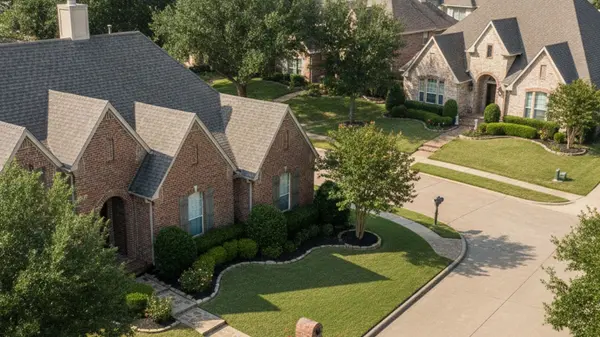
What to Expect for Buyer Closing Costs in Friendswood, TX (2026)
The median sale price for a home in Friendswood, TX sits around $345,000 right now. Homes here go pending in roughly 25 days, which doesn't leave much time to get your finances sorted. This timeline is especially critical for first-time home buyers in Friendswood, TX. Before you write an offer, you need to know exactly how much cash you're bringing to the closing table.
Your down payment is only part of what you'll owe that day. Understanding the full picture of buyer closing costs in Friendswood, TX lets you build a real budget before you're under contract. The buyers who get caught off guard are usually the ones who waited until the title company sent the final numbers.
Understanding Closing Costs for Texas Buyers
Closing costs are the fees, taxes, and prepayments required to finalize a real estate transaction. They cover the administrative work of processing your loan, confirming the property's value, and legally transferring the deed. You pay them at the settlement table, right before you get the keys.
In Texas, those charges are split between buyer and seller. The division follows regional customs, but nearly every line item is technically negotiable in the contract.
Closing costs versus your down payment
Your down payment is the upfront chunk of the purchase price that goes directly toward your equity. Closing costs are entirely separate - they don't reduce your loan balance by a single dollar.
Lenders treat these as two distinct buckets of money. Your Loan Estimate will show both figures added together as your total cash to close, so don't let that combined number catch you off guard.
How buyer costs compare to seller costs
Sellers generally pay a higher overall percentage at the closing table. Their side includes agent commissions, which make up the bulk of their expenses - sellers in Texas often pay 6% to 10% of the sale price in total fees.
Buyers face a smaller percentage, but it still adds up to a real out-of-pocket number. Most of what you'll owe relates to securing the mortgage and funding the initial escrow accounts for taxes and insurance.
Average Closing Costs for Buyers in the Houston Area
Buyer closing costs in Texas typically run between 2% and 6% of the purchase price. On a median-priced Friendswood home at $345,000, that's $6,900 to $20,700. Most local transactions land somewhere in the tighter 2% to 5% range.
Statewide data puts the average Texas buyer at roughly $4,548 before variable escrow reserves are factored in. On a $450,000 property, those figures scale up to between $8,500 and $22,500 depending on the lender and the local property tax rate. The spread is wide, which is exactly why you shouldn't rely on a single headline number.
Why the three percent rule of thumb exists
A lot of real estate professionals tell buyers to budget 3% of the purchase price as a baseline. It's a reasonable middle-ground estimate for most loan types, assuming standard origination fees and typical prepaid property taxes for the region.
It's a starting point, not a guarantee. Cash buyers skip the lender fees entirely, which pulls their percentage down significantly. Buyers with certain loan structures or higher-priced homes can land well above it.
Factors that push costs higher in Friendswood
The biggest variable for local buyers is property taxes. Your lender will require you to fund an escrow account at closing, meaning you're prepaying several months of property taxes plus a full year of homeowners insurance before you ever make your first monthly payment.
Texas funds itself through property taxes rather than a state income tax, and that reality shows up clearly on closing disclosures here. The prepaid section of your statement will likely be the single largest chunk of what you owe - bigger than most buyers expect the first time they see it.
Examples of Buyer Closing Costs by Home Price in Friendswood
Your final number scales with your loan amount, so even a modest bump in purchase price moves the cash requirement at the title company. Closing late in the year also tends to mean different tax prepayment amounts than closing in spring, so the time you close matters too.
Sample estimates for local price points
Applying the 2% to 5% range to common price points gives you a working target. At $300,000, plan for $6,000 to $15,000. A $400,000 purchase puts you in the $8,000 to $20,000 range. At $500,000, expect $10,000 to $25,000. Buyers looking at $600,000 properties should have $12,000 to $30,000 ready.
Those are ranges, not quotes. Your actual number depends on the specific mortgage product you're using and what you've negotiated with the seller.
Figuring out your specific cash to close
Within three days of submitting your loan application, your lender is required to provide a Loan Estimate. That document breaks out every projected fee and gives you a firm target instead of a percentage guess.
Pull estimates from more than one lender. Origination charges vary, and comparing them side by side is one of the simplest ways to cut your closing costs before you've even made an offer.
A Line-by-Line Look at Your Closing Expenses
The statement you receive from the title company will list dozens of individual line items. They fall into three main buckets: lender fees, third-party services, and prepaid property expenses.
Knowing what each line represents helps you spot errors and identify charges worth questioning. Some fees are set by local governments and don't move. Others vary widely depending on who you hire.
Origination fees and appraisal charges
Your lender charges an origination fee to underwrite and process the mortgage - usually between 0.5% and 1% of the total loan amount. You'll also pay for a home appraisal, typically a few hundred dollars, to confirm the property's market value before the loan can close.
Title insurance customs in Galveston County
Title insurance protects against past ownership claims or liens that surface after you close. In Texas, effective March 1, 2026, title insurance premiums dropped by roughly 6.2%, which offers slight savings for both buyers and sellers.
There are two policies involved: the owner's policy and the lender's policy. In Galveston County, as is customary across Texas, the seller routinely pays for the buyer's owner's title insurance policy. You, as the buyer, cover the lender's policy.
Property taxes and escrow reserves
Texas has no state-level real estate transfer tax, which removes a significant expense that buyers in other states have to absorb. Galveston County recording fees are minimal - $25 for the first page of a Real Property Record, and $4 for each additional page.
What Texas buyers do pay is the upfront escrow funding. Lenders collect several months of property taxes at closing to make sure the end-of-year tax bill is covered. That requirement, combined with a full year of homeowners insurance, is where a lot of buyers feel the sticker shock.
Splitting the Bill Between Buyer and Seller
The contract spells out who pays for what. State regulations govern certain insurance rates, but the division of most fees is a negotiable market convention, not a legal mandate.
The standard Texas real estate contract includes checkboxes and blanks for assigning these costs. Friendswood generally follows Galveston County norms on how expenses are divided.
Expenses the buyer typically handles
You're on the hook for everything tied to your mortgage - origination fees, credit report pulls, and the appraisal. The buyer also pays for the home inspection and the lender's title insurance policy. And you'll fund your own escrow account for future property taxes and insurance premiums.
What the seller customarily covers
Sellers pay the real estate agent commissions for both sides of the transaction, along with any property taxes prorated through the day of closing. In Friendswood, sellers customarily pay for the owner's title insurance policy on your behalf and handle any fees needed to clear existing liens or judgments from the title.
Ways to Lower Your Out-of-Pocket Expenses
With Friendswood homes spending around 25 days on the market, you occasionally have room to negotiate with sellers who need to move. Timing and a little preparation go further here than most buyers realize.
You can also trim your upfront burden by comparing mortgage estimates carefully. Small differences in lender fees and interest rates have a real impact on what you wire at closing.
Asking for seller concessions
A seller concession is a specific dollar amount the seller agrees to contribute toward your closing costs. Some active MLS listings in Friendswood already show sellers offering these contributions upfront to attract buyers.
You can negotiate them during the initial offer or after the home inspection comes back. How receptive a seller is depends on how many offers they have and how long the property has been sitting.
Shopping around for lender credits
Another option is accepting a slightly higher interest rate in exchange for a lender credit - the lender uses the extra yield from that higher rate to offset some of your closing costs.
It reduces what you need to wire on closing day, but it raises your monthly payment. Run the math on how long you plan to stay in the home before you decide whether the short-term savings are worth the long-term interest cost.
Estimating expenses for a cash purchase
Cash buyers skip the lender fees, the appraisal, and the lender's title policy entirely, which cuts the total closing costs dramatically. What's left is mostly property inspections, a share of the escrow fees, and the small Galveston County recording charges.
Without a mortgage, you also avoid the mandatory upfront escrow funding for taxes and insurance - which, as mentioned, is often the biggest line item for financed buyers.
Frequently Asked Questions About Friendswood Closing Costs
What percentage of the purchase price should I expect to pay in buyer closing costs in Friendswood?
Expect to pay between 2% and 5% of the purchase price. On a median-priced Friendswood home at $345,000, that translates to roughly $6,900 to $17,250. That range covers loan fees, the lender's title policy, and prepaid property taxes.
Do Friendswood neighborhoods typically have MUD taxes or high HOA transfer fees due at closing?
The exact fees depend on the specific property, since Texas buyers must fund property tax escrows that reflect local district rates. While some areas have municipal utility districts, all Friendswood buyers avoid state and county real estate transfer taxes - you're only paying the small Galveston County recording fees, like $25 for the first page of a public record.
How common is it to get the seller to pay my closing costs in the current Friendswood market?
It's a negotiable market convention here. Some active MLS listings show sellers already offering to contribute toward buyer closing costs as a concession. Sellers also customarily pay for the owner's title insurance policy.
Will my property tax escrows at closing differ depending on whether the Friendswood home is in Galveston or Harris County?
Yes - your prepaid escrows are tied to the specific property tax rate of wherever the home sits. Friendswood properties in Galveston County are subject to that county's tax assessments, though buyers across the area benefit from having no state or county real estate transfer tax at closing.
Are there any first-time homebuyer programs that help cover closing costs for properties in Friendswood?
Specific local assistance programs vary, so check what's currently available. First-time buyers in Friendswood still face the standard 2% to 6% closing cost range regardless. Review your Loan Estimate carefully to see exactly how much cash you need after any negotiated seller concessions or lender credits are applied.
When will I get the final Closing Disclosure with the exact amount I need to wire for my Friendswood home?
Your lender will send the final Closing Disclosure shortly before your settlement date. It replaces the initial Loan Estimate and details the exact total - including loan fees, Galveston County recording charges, and prepaid escrows - so you know precisely what to wire.
Categories
Recent Posts